Your RRSP Refund Isn't Free Money

rrsptfsataxguide

Every February, Canadians celebrate their RRSP tax refund like they found money in a coat pocket. A few thousand dollars hits your bank account and it feels like a gift from Ottawa.

It isn’t.

The refund is the government buying a stake in your retirement account. Once you see it that way, the whole RRSP stops feeling like a confusing tax trick and starts making sense. If you’ve never read the basics, start with What is an RRSP?. This post builds on that.

The refund isn’t free money: it’s equity

Say you contribute $10,000 to your RRSP and your marginal tax rate is 40%. You get a $4,000 refund.

Most people treat that $4,000 like a bonus. Spend it on a vacation, pay down the credit card, buy a nicer couch. But that money was never yours to keep. The CRA was holding it because you hadn’t told them yet that you made an RRSP contribution.

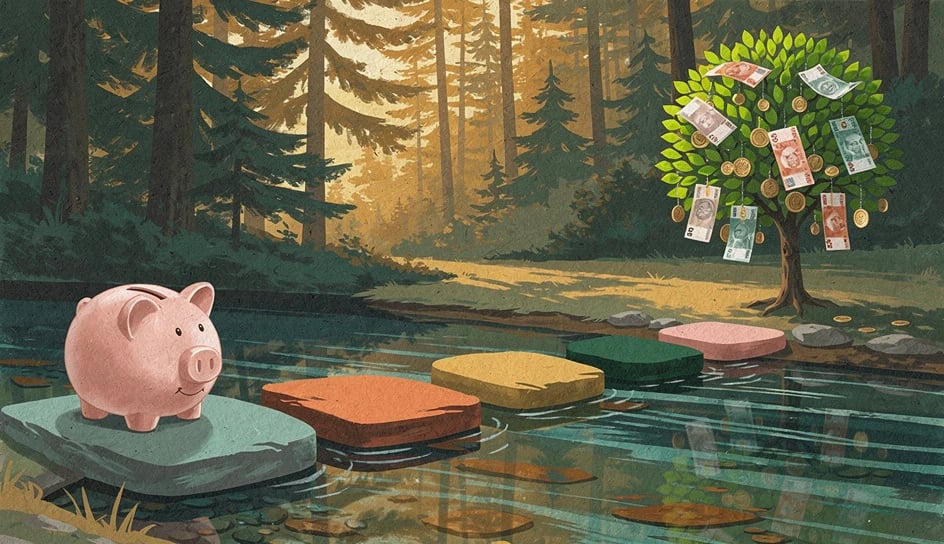
A cleaner way to think about it: the government just bought a 40% equity stake in your RRSP.

You put in $6,000 of your own after-tax dollars. The government put in $4,000 through the tax system. Your RRSP statement shows $10,000, but only $6,000 of that is actually yours. The other $4,000 belongs to the CRA, and they’ll collect it when you withdraw.

At withdrawal, they take their share. If your RRSP grows to $100,000 and you’re still at a 40% marginal rate, the government gets $40,000 and you keep $60,000. Same split as the day you contributed.

When your contribution rate and withdrawal rate match, the RRSP and TFSA produce the same after-tax result. I walked through the math in RRSP is a TFSA in disguise: same dollars in, same dollars out. The RRSP just looks bigger on paper because the government’s share is sitting in there too.

The mental model that changed things for me: whenever I look at my RRSP balance, I mentally split it in two. “My money” and “the government’s money.” My actual net worth from the RRSP is only the after-tax portion. A $200,000 RRSP at a 30% withdrawal rate means I really have $140,000. The other $60,000 was never mine.

What happens if you skip the RRSP entirely?

Let’s make this concrete. Meet someone earning $90,000 in Ontario with $6,000 of after-tax money to invest each year for 30 years. We’ll assume 7% annual returns and a passive index fund with negligible MER.

At $90,000 in Ontario, the combined federal and provincial marginal rate is about 30%. If they skip the RRSP and invest in an unregistered account holding something like VEQT instead, here’s what 30 years looks like:

RRSP Unregistered (VEQT)
Annual investment ~$8,529 gross ($6,000 after-tax equivalent) $6,000 after-tax
Balance at year 30 (before tax) ~$862,000 ~$606,000
Taxes paid ~$200,000 to CRA at withdrawal (~23%) ~$27,000 on dividends (annual, ~1.5% yield × 30% rate) + ~$39,000 on capital gains at sale
You keep ~$662,000 ~$540,000

That’s a spread of over $120,000, just from using the right account type. The unregistered account starts with less money going in each year ($6,000 vs the RRSP’s gross equivalent), and what does get invested gets nibbled at twice: dividends taxed every year, capital gains taxed when you sell.

Here’s the part that surprised me when I ran the numbers: even if you buy VEQT and never sell until retirement, you still lose to the RRSP. VEQT’s distribution yield is only about 1.5% (mostly eligible Canadian dividends plus foreign income), so most of the return is deferred capital gains. That keeps the unregistered account closer to the RRSP than a high-yield dividend fund would. But those quarterly distributions still show up on your T3 every year, taxed at your full marginal rate while you’re working. Over 30 years that adds up to roughly $27,000 in dividend tax alone.

The RRSP advantage gets bigger as the spread between your contribution rate and withdrawal rate widens. Contribute at 30%, withdraw at 20%, and the government partnership pays off twice: you put in more upfront (via the refund), and you settle up at a lower rate later.

There’s another edge that’s easy to miss: inside an RRSP, you can sell and rebalance without triggering capital gains. Need to shift from VEQT to something more conservative at 60? No tax event. In an unregistered account, every rebalance is a potential tax bill. The government is still a silent partner in your RRSP, but at least they stay quiet while your money is growing.

The real RRSP wins come from three things: (a) no tax on dividends while invested, (b) no capital gains tax when you rebalance, and (c) the contribute-high, withdraw-low rate spread. Even with a low-churn fund you never touch, (a) alone is enough to put the RRSP ahead.

Check the numbers yourself with the RRSP vs TFSA vs Unregistered calculator:

Should I max my TFSA before touching my RRSP?

This is the question I get most often, and the answer is annoyingly personal.

Same person, $90,000 in Ontario, $6,000 after-tax to invest. Two paths:

TFSA path: contribute $6,000, no deduction, tax-free growth, tax-free withdrawal. After 30 years at 7%: about $606,000.

RRSP path: contribute ~$8,529 gross (same $6,000 out of pocket), get a ~$2,529 refund, tax-free growth, taxed at withdrawal. If retirement income puts them in a ~23% bracket instead of today’s ~30%, they keep about $662,000 after tax.

The RRSP wins by roughly $56,000 here. That spread is the difference between your marginal rate at contribution and your marginal rate at withdrawal. Contribute high, withdraw low, and the RRSP comes out ahead.

But it cuts both ways. If you’re in a low bracket now and expect a higher one in retirement (say 25% today and 33% later), the TFSA wins by about $65,000 over the same period. Same math, reversed direction.

The answer depends on where you think your income will land in retirement relative to today. For most people earning $75,000 or more, retirement income is typically lower. Median individual retirement income in Canada sits around $27,000 to $35,000, which puts you in a much lower bracket than a $90,000 salary. That’s why the RRSP usually has the edge for mid-to-high earners.

If you’re stuck deciding, the Investment Account Selector walks through the same logic and gives you a prioritized recommendation. I also covered the general rules in TFSA or RRSP or Unregistered.

But I’ll STILL be in a high bracket in retirement

Fair pushback. Say you’re earning $150,000 in Ontario, marginal rate around 45%. You expect to retire comfortably and withdraw at a similar rate. Why bother with the RRSP?

Two reasons.

First, even at equal rates, the RRSP still beats unregistered investing. At 45% contribution and withdrawal rates, your RRSP after-tax balance and TFSA balance are identical, about $606,000 on $6,000/year for 30 years. But the unregistered account holding VEQT? About $490,000 after dividend tax drag and capital gains tax. That’s a $116,000 gap, and you didn’t need a lower retirement bracket to get it. You just needed tax-free compounding instead of paying tax on dividends every year plus gains at sale.

Second, you can get the “refund” upfront instead of waiting until April. If you’re in a high bracket and contributing regularly, fill out a T1213 to reduce source deductions at your employer. You get the co-investment money monthly in your paycheque instead of as a lump sum refund. That lets you contribute the full gross amount to your RRSP without floating the government their share for a year.

And remember the equity framing: at a 45% rate, only 55% of your RRSP balance is yours. A $500,000 RRSP really represents about $275,000 of your money and $225,000 the government will collect at withdrawal. That’s not the CRA stealing from you. That’s you returning their share of a partnership that’s been compounding tax-free for decades.

Why the language matters

When people say “the government taxes my RRSP,” it feels like something is being taken away. Like you saved diligently and Ottawa showed up at the door to grab a cut.

When you say “I’m returning the government’s share,” it feels neutral. Expected. Part of the deal you signed up for when you took the deduction.

That framing matters more than you’d think. Research on decision-making (like Sheena Iyengar’s work on choice overload and Barry Schwartz’s Paradox of Choice) shows that anxiety about financial decisions often leads to inaction, not better decisions. I’ve seen this firsthand: people paralyzed between TFSA and RRSP end up doing neither, leaving money in a chequing account earning nothing. I wrote about that dynamic in the context of picking ETFs, but it applies here too: VEQT vs XEQT: Pick One and Move On.

Reframing the RRSP as a partnership rather than a tax trap removes some of that anxiety. You’re not getting robbed at withdrawal. You’re settling accounts with a co-investor who’s been letting your full balance compound tax-free the whole time.

What to actually do

The RRSP is one of the best deals available to Canadians, full stop.

Use the RRSP when your marginal rate today is at or above what you expect in retirement. Use the TFSA when your rate is low now, or when you need flexibility to withdraw without losing room. Either way, do something. Sitting in cash because you’re unsure which account is “optimal” is the worst option.

If you want to dig deeper:

The refund was never free money. It was the government shaking hands on a deal. And it’s a deal worth taking.