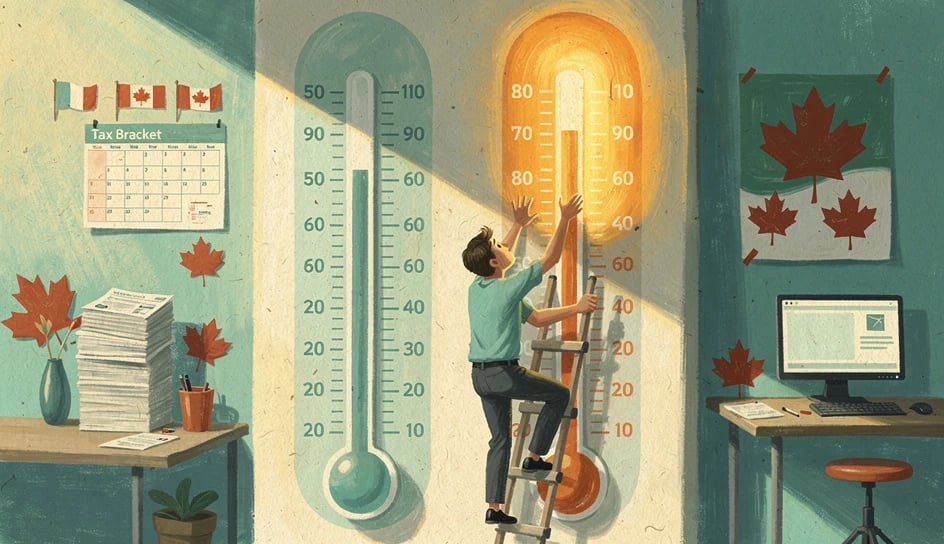
Should you defer RRSP deduction until you're in a higher bracket?
Your RRSP’s greatest strength is increasing your tax return, allowing you to save more capital quickly. That refund is the government buying a stake in your account—not a bonus—explained in Your RRSP Refund Isn’t Free Money. Depending on your income, many people recommend “deferring” your RRSP tax deduction to a future tax year. Is this really a valid strategy?
Bob and Alice
Bob and Alice are co-workers. Both earn $44,850 in 2020 and get a $10,000 raise starting January 2021. Each contributes $8,000 to their RRSP every year. Bob claims his deduction immediately. Alice carries hers forward to claim at a higher marginal rate.
Year 1 (2020): Same salary, same contribution
Both earn $44,850 and contribute $8,000 to their RRSPs.
| Bob | Alice | |
|---|---|---|
| Deduction claimed | $8,000 | $0 (carried forward) |
| Tax refund | $1,600 | $0 |
| Refund invested outside RRSP | $1,600 | $0 |
- Bob claims his deduction immediately. Gets a $1,600 refund. Invests it.
- Alice carries her deduction forward. Gets $0 refund. Her money sits in the RRSP growing, but no extra capital to invest elsewhere.
Year 2 (2021): Raise to $54,850
Both contribute $8,000 again.
| Bob | Alice | |
|---|---|---|
| Deduction claimed | $8,000 | $16,000 (two years) |
| Tax refund | $1,920 | $4,090 |
| Total outside investments (at 7% growth) | $3,632 | $4,090 |
- Bob claims $8,000 at the higher rate. Gets $1,920 refund. His Year 1 refund has already been growing at 7% for a year. Total outside investments: $3,632.
- Alice claims $16,000 (two years’ worth) at the higher rate. Gets $4,090 refund. Total outside investments: $4,090.
The gap: $458. Alice made 12% more by deferring.
What’s the break-even return?
Alice’s gamble paid off because she got a 9% higher marginal rate (20% to 29%). But Bob had his $1,600 invested for a full year before Alice got anything. If the market returned more than X% that year, Bob would have come out ahead despite the lower refund rate.
The break-even point depends on the rate spread. With a 9% spread on $8,000, Alice’s extra refund is $720. Bob had $1,600 invested for one year. He needs $720 / $1,600 = 45% return to match Alice. That is extremely unlikely in one year, which is why deferring works when the rate spread is large.
But shrink the spread to 3% (say, a $2,000 raise instead of $10,000) and the math changes. Alice’s extra refund drops to $240. Bob needs $240 / $1,600 = 15% to break even. That is aggressive but not impossible. At a 1% spread, Bob only needs 5% to win.
Deferring is not free money. If Alice’s income drops in 2021 (leave, layoff, life), the gap shrinks or reverses. A 20%+ raise with a 9-point marginal rate jump is uncommon, and you rarely know your next year’s income with certainty. TL;DR: Maybe. The opportunity cost of waiting is certain; the higher refund is a bet.
Two key benefits of the RRSP
- You get a tax deduction which reduces your tax burden. For example: if you make $40,000 your marginal rate is ~20%. If you contribute $5,000 to your RRSP and claim the deduction you will get $1,000 extra back on your income tax ($5,000 × 0.20 = $1,000).
- Buying/selling in an RRSP (or TFSA) does not trigger capital gains. You invest for the long term and buy a growth index fund in your RRSP, but later change your mind and want to use the Home Buyers’ Plan, you can switch to a conservative portfolio while you look for a house without triggering capital gains.
If you deposit $5,000 into your RRSP and you choose to “defer” your deduction you are effectively saying “Hey CRA, you can keep that $1,000 this year,” giving them an interest-free loan from the bank of your retirement. If you’d rather not float that money at all, Get your tax refund early with a T1213 reduces withholding at source instead.
Letting the CRA keep the $1,000 creates an opportunity cost. An opportunity cost is what you miss out on by not performing an action. If you would have taken the deduction you could have invested the refund in a TFSA, RRSP, or unregistered account and made 4 to 7% growth over the year. The RRSP vs TFSA vs Unregistered calculator shows how the government co-invests in your RRSP and compares all three account types over decades.
But if I’m going to pay higher tax next year, then I should defer?
It is possible that your marginal rate in the future will be higher than it is now, but the opportunity cost of deferring your deduction is certain. Choosing to defer in spite of the opportunity cost depends on your circumstances and risk tolerance. Some cases where this may make sense are:
- You’re a student working part time who is about to graduate and has secured a high-paying job next year.
- You’re a parent who took maternity/paternity leave and had reduced income, and next year it will return to normal.
- Your employer compensates you with RSUs that have an initial vesting period, this can result in your second year of employment having a much higher income than your first year.
All of these situations are reasonably optimistic: job offers get rescinded, you may cut your paternity/maternity leave short, and your employer may have layoffs before your RSUs vest. If any of this does occur you would be hoping that you did take the tax deduction when you had the chance.
Bottom line
A bird in hand is better than two in the bush.
I generally claim my deduction in the year I contribute unless I have a specific, high-confidence reason to expect a materially higher marginal rate next year. The math only works when the income bump is large and predictable, and even then you’re betting against certainty. When marginal rates match at deposit and withdrawal, the RRSP and TFSA produce the same outcome—I proved that in RRSP is a TFSA in disguise. For which account to fund first, see TFSA or RRSP or Unregistered.
If you want to learn more about the RRSP you can check out this article: